Magento 2.4.6 end of support: what now?
Since 11 August 2026, Magento Open Source 2.4.6 has received no security patches, and on 31 December support ends for PHP 8.2 — the highest version it runs on. Adobe's extended support covers paid Adobe Commerce only, and no third party sells patches for Magento 2 — which leaves four options: upgrade to 2.4.9, Mage-OS, Adobe Commerce or a new platform. This article matches each option to your situation — and shows when upgrading is a poor idea.
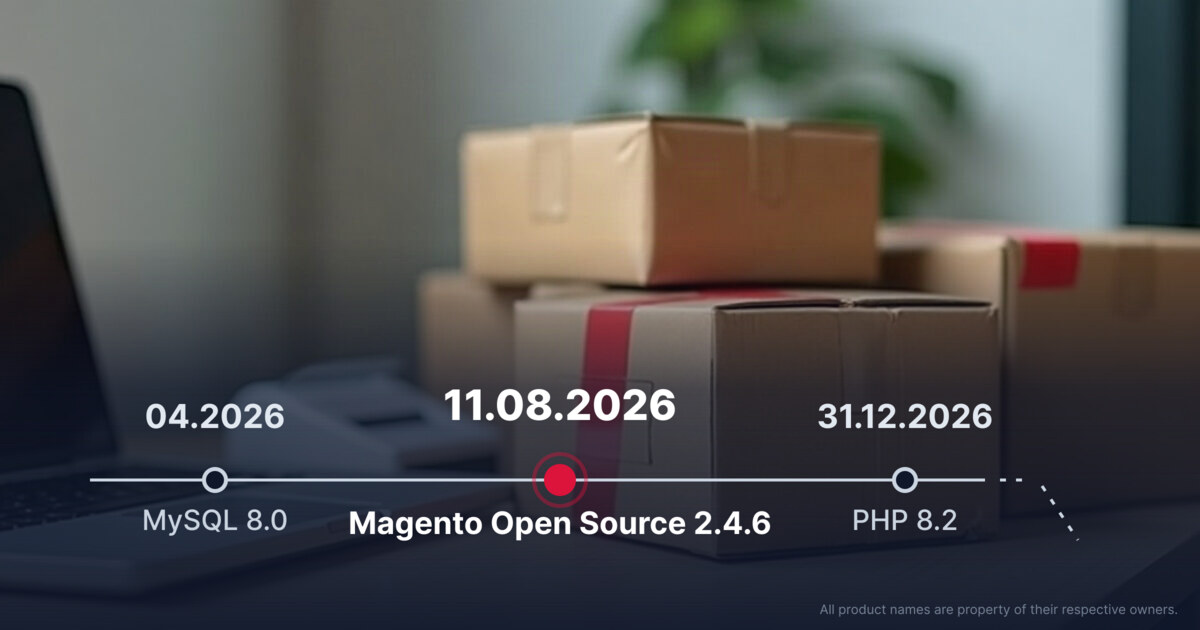
Six dates that frame the whole decision
All of them come up again later in the article:
- 11 August 2026 — end of support for Magento Open Source 2.4.6; for this edition it means no more patches at all.
- 31 December 2026 — end of security support for PHP 8.2, the highest PHP version 2.4.6 runs on.
- April 2026 — MySQL 8.0 moves to Oracle Sustaining Support; Adobe advises stores on 2.4.4–2.4.7 to migrate to MariaDB.
- 31 May 2027 — end of regular support for Magento 2.4.7.
- 31 May 2029 — support end date for 2.4.9, released on 12 May 2026.
- 10 November 2025 — the Hyvä theme goes open source; 7,000+ stores use it (per Hyvä's own data).
My store runs 2.4.6 — what exactly has happened?
Since 11 August 2026 your store has been running without security patches. End of support means Adobe no longer ships fixes for this version: the store keeps selling, but every newly discovered security hole stays open. The last patch in the line, 2.4.6-p15, shipped on 12 May 2026 — the formal end date, however, is 11 August, and that is the date we use throughout this article.
This is not one deadline but three. After August, the platform itself gets no patches. On 31 December 2026, support ends for PHP 8.2 — and this edition does not run on anything newer. The third deadline has already passed: Oracle stopped active support for MySQL 8.0 in April 2026, which is why Adobe recommends moving to MariaDB. In short: two of the three deadlines are behind you, the third expires at the end of the year.
Can I simply stay on 2.4.6?
You can — briefly and deliberately, as a bridge, not a strategy. This option fits a store that has already decided to migrate and wants to get through Q4 without touching the platform. A controlled bridge has three ingredients: a change freeze, a web application firewall (WAF) with monitoring and an exit plan with a fixed date.
Trouble starts when "we'll stay for now" drags on for quarters. Since August, nobody has been patching holes in 2.4.6, and after December the PHP underneath stops being patched too. Every week of delay adds debt — in security and in decision-making. The horizon for this option is measured in weeks.
Upgrading to 2.4.9 — what am I buying and how big is the jump?
You are buying a supported platform until 31 May 2029 — but the jump is bigger than the version number suggests. Going from 2.4.6 to 2.4.9, you jump three PHP versions (8.2 → 8.5) and replace the database: MySQL 8.4 or MariaDB, per the system requirements. A "Magento upgrade" is in practice a modernisation of the whole stack, and the cost sits mostly in modules and integrations — the core itself is the smallest part of the work. The 2.4.x line is an LTS line: Adobe commits to a full patch every May.
An upgrade can also be a poor idea. It is not worth doing when the cost of adapting your modules approaches the cost of moving to a new platform. The timing is also wrong when the business has outgrown the platform (the checklist below lists the symptoms), or when there is nobody — in-house or at a partner — to run a PHP 8.5 stack. In those three cases, 2.4.9 merely postpones the same decision by a year.
Mage-OS: a leap forward, not "patches for your old version"
Mage-OS will not ship patches for your 2.4.6. This independent Magento distribution patches the latest release branch only — its release policy states it plainly: "security patches and updates for the latest release branch only". Adobe's fixes land in the current branch within days, but the idea of "switching to Mage-OS and staying on the old version" is a myth.
Behind the distribution stands a volunteer-run non-profit association, registered in Poznań, Poland, in 2022. The project promises full compatibility with Magento extensions and themes; the automated migration script covers Magento 2.4.8 and newer. The current release 3.5.0 is built on Magento 2.4.9: PHP 8.3–8.5 and MySQL 8.4 or MariaDB 11.4+. For a store coming from 2.4.6, moving to Mage-OS is the same technological jump as an upgrade — and since the cost of the move is the same, the difference comes down to independence from Adobe's decisions. There is no commercial SLA.
A good fit: stores with their own developers or a trusted partner that want to escape a single-vendor dependency. A poor fit: anyone looking for "patches for the old version" and companies that need contractual support guarantees.
What about paid extended support?
For Magento Open Source, such an offer effectively does not exist. Adobe gives 2.4.6 and 2.4.7 one extra year of support at no additional cost, but exclusively to paying Adobe Commerce customers — per the lifecycle policy. The policy document adds: "this Policy does not apply to Magento Open Source". Commerce pricing is quote-based, and moving to it is a product change, not a way to buy patches. We found no third-party patch offering for Magento 2 past end of support (as of 16 September 2026) — precedents exist only for Magento 1.
Front-end modernisation is a separate topic. The Hyvä theme has been open source and free since 10 November 2025; per Hyvä's own data, more than 7,000 stores use it. Hyvä Checkout, Enterprise and Commerce remain commercial. For your decision this means the storefront can now be refreshed without licence fees — but it does not replace core patches.
When is it time to replatform from Magento instead of upgrading?
Replatforming is a portfolio decision: you change the foundation because the platform can no longer keep up with the business, not because a date on the calendar has passed. Four simple tests — the more "yes" answers, the stronger the case for a new platform:
- the quote for adapting modules and integrations to the new version comes close to the price of building the store on a new platform;
- the store holds sales back: features or integrations are missing, and changes take months to ship;
- maintenance costs more every year, and people who know Magento 2 are ever harder to find;
- a growing share of your modules is no longer being developed by anyone.
With one or two "yes" answers, price the upgrade option and negotiate the scope. With three or four, treat 2.4.9 as the cost of postponement and compare it against a replatforming quote before you sign anything.
On 16 September 2026 we checked what AI advises on this question. Asked about Magento upgrades, Perplexity drew 19 of its 20 sources from implementation agencies' blogs, while ChatGPT cited Adobe documentation exclusively. There was no independent voice in those answers; a checklist that serves your store's own interests is something you must bring yourself.
PrestaShop 1.7 and 8 face the same cliff
A store on PrestaShop 1.7 or 8 faces structurally the same decision — from a worse starting point. PrestaShop announced back in 2023 that support for the 1.7 line would end with the release of version 9 — which shipped on 10 June 2025. The highest PHP that 1.7 runs on (7.4) lost support back in November 2022. The 8.2 line receives only critical and security fixes, plus new hooks until version 10 ships, and its highest PHP, 8.1, has been unsupported since 31 December 2025. The choice looks identical: upgrade to PrestaShop 9 or change platforms — with the same checklist as above.
The Q4 decision: where to start
There are four options; the row "stay on 2.4.6" is a transition plan, not a fifth option.
| Option | What it means technically | Main risk | Who it fits |
|---|---|---|---|
| Stay on 2.4.6 (briefly) | change freeze, WAF and monitoring, exit plan with a date | no patches since 11.08.2026; PHP 8.2 ends 31.12.2026 | a store with the decision already made, bridging Q4 |
| Upgrade to 2.4.8/2.4.9 | PHP jump 8.2 → 8.4/8.5, database swap, module adaptation | the cost is in modules and integrations | the platform fits the business; a team or partner exists |
| Mage-OS 3.x | the same technological jump, distribution swap in composer | volunteer non-profit, no SLA; latest-branch-only policy | stores with dev skills wanting independence from Adobe |
| Adobe Commerce (paid) | the only form of extended support (2.4.6 until 31.08.2027) | licence cost; a product change | large stores with enterprise needs |
| Replatforming | platform change — a migration project | the longest time and highest cost | stores whose platform holds the business back (checklist above) |
The most common Q4 choice is the upgrade — provided your modules pass a compatibility audit. Mage-OS makes sense when you have development skills and want independence from Adobe's decisions. Replatforming wins when the checklist above lights up — then every euro put into an upgrade postpones the decision instead of making it.
If you would rather have this decision prepared by someone who sells neither upgrades nor migrations, that is exactly what the ecommerce diagnosis does: 2–4 weeks, €3,000–5,500 net. It identifies the area that blocks results, recommends a direction with its trade-offs, and gives you a 90-day plan.